How to Get Online Fitness Clients: The 9-Step Roadmap for Online Coaches
Learn the exact system to get online coaching clients. Fix your fitness niche, write a high-converting Instagram bio, send organic DMs, and run diagnostic sales calls.
If you spend 12 hours a day working on your fitness coaching business and still do not have enough clients, working harder is not the solution.
Fixing your Instagram post does not matter if your niche is too broad.
Sending organic DM outreach does not work if your Instagram profile looks like everybody else.
Tweaking your sales script is useless if prospective clients lack the baseline trust needed to book a discovery call.
Building a profitable online fitness coaching business requires executing specific steps in the right order.
1. Pick an Online Coaching Niche Based on Your Personal History
When your offer claims to help everyone lose weight, you end up helping no one. Broad messaging forces you to compete directly with established trainers who have massive social media followings.
The easiest way to pick a profitable niche is to build your program for the exact person you were three to five years ago:
The Desk Worker: If you lost thirty pounds while working fifty-hour weeks at a corporate job, target busy professionals struggling with sedentary routines.
The Post-Injury Overcomer: If you recovered from lower back pain through structured strength training, position yourself as a specialist for lifters recovering from injuries.
The Busy Parent: If you managed to lose weight while taking care of young children, create a fitness program tailored exclusively for parents with limited free time.
Once you select your target audience, write down their daily struggles.
Focus on real problems like:
The busy parent eats fast food twice a week because they get home at 7:00 PM exhausted.
The postpartum moms are afraid of going to a commercial gym because they don't know how to set up the cable machine.
Desk job workers want to lose 15 lbs so their work clothes fit comfortably without buying a larger size.
Creating content for social media around those exact pain points helps your prospect clients feel understood, it helps position you as the expert.
2. Turn Your Instagram Profile into a High-Converting Landing Page
When a prospective fitness client visits your profile, you have roughly three seconds to prove you can help them achieve their goals.
Your profile picture should be a clear, high-resolution headshot from the chest up, taken in good lighting where you look directly at the camera.
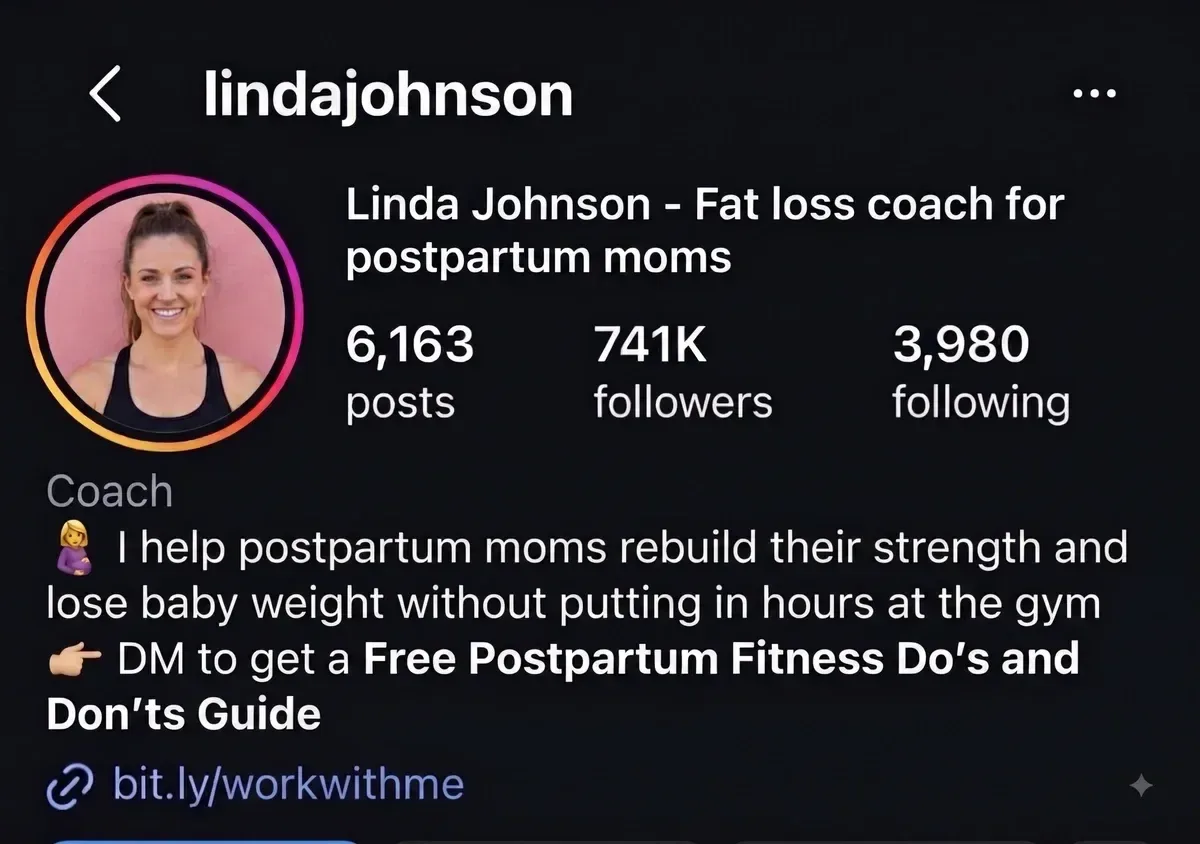
Treat your name line like a search bar. Instead of writing "Fitness Enthusiast," write "Your Name | Fat Loss Coach for Busy Dads." This helps your account show up when potential clients search for fitness coaches on Instagram.
Write a clear Instagram bio that explains who you help, the exact outcome you deliver, and the main obstacle you help them avoid. A strong example looks like this: "I help corporate professionals drop 20 pounds without cutting out weekend social events or doing hours of cardio."
Include a clear call to action in your bio instructing users to send a specific keyword in your DMs to receive a free guide or application. Place a single link below your bio that leads directly to a brief client application form.
Setting Up Your Client Application Form
Keep your application form short to avoid overwhelming leads. Ask four fundamental questions:
What is your primary fitness goal right now?
What is the main obstacle stopping you from reaching this goal on your own?
Have you worked with a personal trainer or online fitness coach before?
Are you ready to invest between $200 and $400 a month if we are a good fit?
The final question filters out unqualified leads before you invest time in a dedicated sales call.
3. Keep Your Coaching Tech Stack Simple
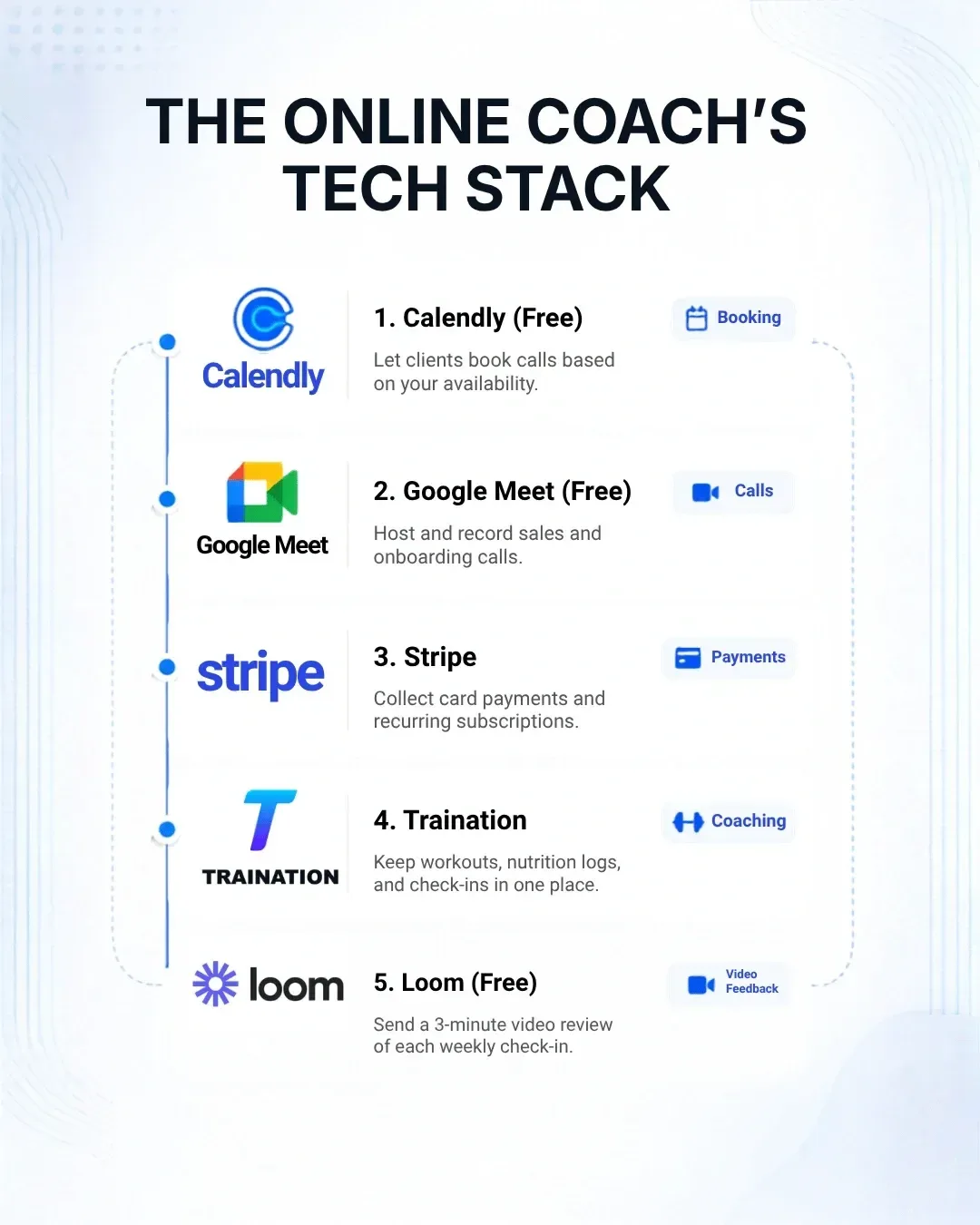
Avoid spending hundreds of dollars a month on complicated software subscriptions when you are managing fewer than ten clients. You only need five simple tools to run an efficient coaching workflow:
Calendly (Free): For clients to book call times based on your availability.
Google Meets (Free): To host and record your sales and onboarding calls.
Stripe: To collect credit card payments or set up recurring monthly subscriptions.
Traination: To store your client's workout programs, review their daily nutrition logs, and receive check-in responses in one place instead of scattered across WhatsApp and email.
Loom (Free): To record a 3-minute video response reviewing your client's weekly check-in sheet.
4. Design a High-Ticket Coaching Offer Built Around Results
Avoid selling single personal training sessions or inexpensive custom workout plans. Instead, package your services into a complete ninety-day transformation program.
Your workout programming should update every regularly inside your coaching platform to ensure progressive overload and keep clients engaged.
For nutrition coaching, start beginners on a simple meal framework with three distinct choices for breakfast, lunch, and dinner. Transition them to flexible macro tracking during their third week once they have established consistency.
Enforce a mandatory weekly check-in form every Friday morning. Ask about their average morning weight, completed workouts, sleep quality, weekly wins, and primary struggles.
Price your ninety-day coaching package at $900. Give clients the option to pay upfront for $800 to encourage immediate cash flow, or offer three monthly payments of $300 to make the program accessible to different budgets.
5. Publish Content That Builds Trust and Drives Organic Leads
Publish content once a day, alternating between three core media formats designed to build trust and generate fitness leads.
Connection Posts: Share your personal story, past struggles, and bad days. When you speak openly about how you overcame a major fitness obstacle, prospective clients realize you understand their current situation.
Tactical Value Posts: Provide immediate, actionable solutions to narrow problems. Instead of posting general advice about healthy eating, break down a five-minute high-protein meal prep idea or explain how to make low-calorie order adjustments at popular restaurants.
Proof Posts: Share client success stories, transformation photos, and screenshots of positive client messages. Social proof demonstrates that your coaching program delivers results.
6. Convert Instagram Engagement into Sales Calls
Sending cold pitch messages to strangers can damage your brand reputation and leads to account restrictions on social media platforms.
Instead, focus all organic DM outreach on people who have already shown interest by liking your posts, voting on your Instagram story polls, leaving comments, or following your page.
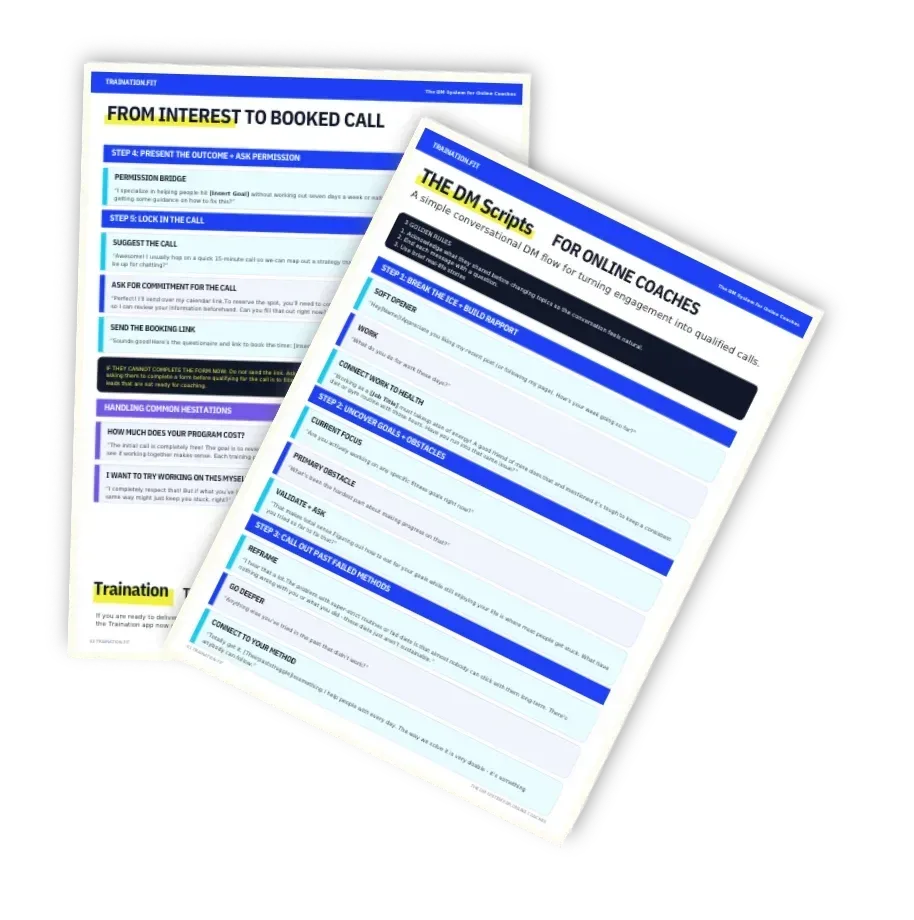
Start every conversation naturally without pitching immediately. Send a simple message acknowledging their interaction and asking about their current fitness routine.
Once they mention a struggle, such as lack of time or inconsistent diet habits, ask how long they have been trying to fix that issue. When they express frustration with their lack of progress, ask if resolving that issue over the next ninety days would make a meaningful difference for them.
If they confirm it is a priority, invite them to a fifteen-minute Zoom call to review their current routine and see if your coaching program fits their needs, then provide your booking link.
Not sure what exactly to say when reaching out to leads? You can download the Free Conversational DM Scripts here.
7. Conduct Sales Calls Like a Diagnostic Evaluation
Structure your sales call like a diagnostic consultation rather than a high-pressure pitch. Spend the first two minutes setting expectations by letting the prospect know you will ask about their goals and challenges, determine if your program is the right fit, and point them toward other resources if it is not.
Spend ten minutes asking diagnostic questions. Find out why they decided to seek help today instead of six months ago, examine their current nutrition and workout habits, clarify their target weight or physique goals, and ask what happens if their health remains unchanged over the next year.
During the final five minutes, present your solution using their exact words. Explain how your workout programming, simple meal strategies, and weekly video check-ins address the specific struggles they mentioned. Present your payment options clearly and ask which option works best for their current budget.
8. Handle Objections Proactively
Common sales objections regarding budget, time, or needing partner approval are usually normal hesitations about making a major lifestyle change. Address these topics early in the diagnostic portion of your call by asking about their previous health investments and decision-making processes.
If a prospect expresses hesitation at the end of the call, avoid arguing or offering an immediate discount. Validate their perspective on finances, then ask if they genuinely believe your program structure will get them to their goal.
If they confirm they trust the strategy, ask if selecting the monthly payment plan makes the investment manageable for their monthly cash flow starting today.
9. Create an Onboarding and Retention Strategy
Client retention forms the foundation of recurring revenue. Getting a client to sign is only the beginning of the relationship; long-term growth requires an exceptional onboarding process and structured extension strategy.
The moment a client submits their payment, send a brief, personalized video welcoming them to the program and giving them immediate action steps to complete inside your coaching app. Replying to their first weekly check-in with detailed video feedback within a few hours sets a high standard for your service early on.
Instead of waiting until the final week of a package to discuss continuing their program, introduce the next phase of their journey around the eighth week. Review their progress, highlight how far they have come, and outline the next performance goals you will target together over the following three months. Frame continuing as the logical step toward maintaining their results.
Unifying Your Fitness Coaching System
A successful online fitness coaching business functions as a single connected system where every piece supports the next.
When you manage your client onboarding, workout delivery, nutrition tracking, and weekly check-ins within a single platform like Traination, you eliminate administrative friction, save time on operations, and build a predictable environment to scale your coaching business.
Want early access to Traination?
Join the beta list to try new features early and help shape the app for coaches.