Fitness Challenge Ideas for Personal Trainers: How to Turn Sign-Ups Into Ongoing Coaching
A high sign-up count doesn’t guarantee new coaching clients. This guide breaks down how personal trainers and online coaches can design fitness challenges that lead naturally into ongoing coaching.
Looking for fitness challenge ideas for personal trainers usually brings up long lists of generic 30-day squat calendars or step contests. A big registration count looks good on social media, but sign-up numbers alone do not tell you if a fitness challenge helped your business. Plenty of coaches run a four-week contest, spend hours policing a leaderboard, and end up with zero new personal training clients when the month is over.
A useful challenge gives a specific group of people a manageable early win and a clear next step. To make challenges worth your time, you have to separate lead generation from client retention, make the challenge look like the actual coaching service you sell, and measure what happens after the final day.

What the Evidence Says About Running a Fitness Challenge for Clients
Fitness software platforms regularly promote challenges as tools to bring in leads, keep clients engaged, and drive repeat sales. Most coaching apps let you group clients together to track workouts, daily habits, and personal bests. Those features are handy for running the event, but vendor guides are commercial resources, not independent proof that running a challenge will increase your retention or sales.
Clinical research shows both the value and the limits of gamified fitness. In the 2019 STEP UP randomized clinical trial (Patel et al.), researchers followed 602 adults with a BMI of 25 or higher for 24 weeks. Everyone used a step tracker and got a step goal, while participants were split into a control group or gamified groups built around social support, collaboration, or competition.
During the 24-week program, all the gamified groups walked more than the control group, and the competition group saw the biggest difference at 920 extra steps per day. Once the 24-week intervention ended, however, those gains faded across the board.
For trainers, this highlights two things. First, structured incentives and competition can increase activity while the game is running. Second, a temporary spike in daily steps does not prove that a participant wants to buy personal training. If you want people to keep training after a challenge ends, the challenge itself has to act as a bridge into ongoing coaching.

Fitness Challenges for Lead Generation vs. Gym Member Retention Challenges
Prospects and current clients need completely different challenge designs. Trying to serve both groups in the same event usually waters down the experience for everyone.
When designing fitness challenges for lead generation, treat the event as a small trial of the coaching service you actually sell. A walking challenge may attract plenty of people who have no interest in paying for a strength coaching membership. A beginner strength challenge lets prospects experience your movement instruction, exercise modifications, and coaching feedback firsthand. Even if you get fewer registrations, the people who sign up are much closer to wanting your paid program.
When running gym member retention challenges or online challenges for existing clients, your roster already knows how you coach. Their challenge should fit directly into their ongoing training program and help them rebuild consistency after travel or schedule disruptions.
5 Online & In-Person Fitness Challenge Ideas for Coaching Prospects and Clients
Instead of running a daily maximal workout grind or a weight loss ranking, test these five structured formats based on who you want to help.
1. The 7-Day Beginner Strength Challenge (For Prospects)
Set up two short workouts, one technique lesson, and a personal follow-up during the week. Use this for prospects who want to start lifting but are unsure where to begin. Because they spend the week experiencing your instruction and modifications, inviting them to a consultation or a paid starter block at the end feels like a natural continuation.
2. The 14-Day Workout Consistency Challenge (For Current Clients)
Have existing clients commit to an individually agreed number of weekly sessions and log one schedule barrier alongside how they solved it. This format works best for current clients who are rebuilding their attendance after a holiday, travel, or a busy stretch at work.
3. The 21-Day Movement Challenge for Desk Workers (For Prospects or Hybrid Clients)
Build a three-week habit-based fitness challenge around short movement breaks tied to the workday, adapted for each person's baseline activity and mobility. Rather than judging the event by sign-up volume alone, evaluate it by how many people actively participate and ask about your relevant coaching offer afterward.
4. The 4-Week Partner Workout Challenge (For Referrals and Retention)
Score participants on completing their own individually prescribed sessions, using a strict weekly points cap so nobody gets rewarded for overtraining. Current clients can invite a friend to join them, provided the friend signs up through a separate opt-in form rather than getting added to your marketing email list automatically.
5. The 4-Week Skill Milestone Challenge (For Current Clients or Warm Leads)
Spend four weeks working toward a suitable squat, push, or loaded carry milestone. Reward technical learning and session consistency, and provide clear exercise alternatives for participants working around pain, disability, or different levels of training experience.
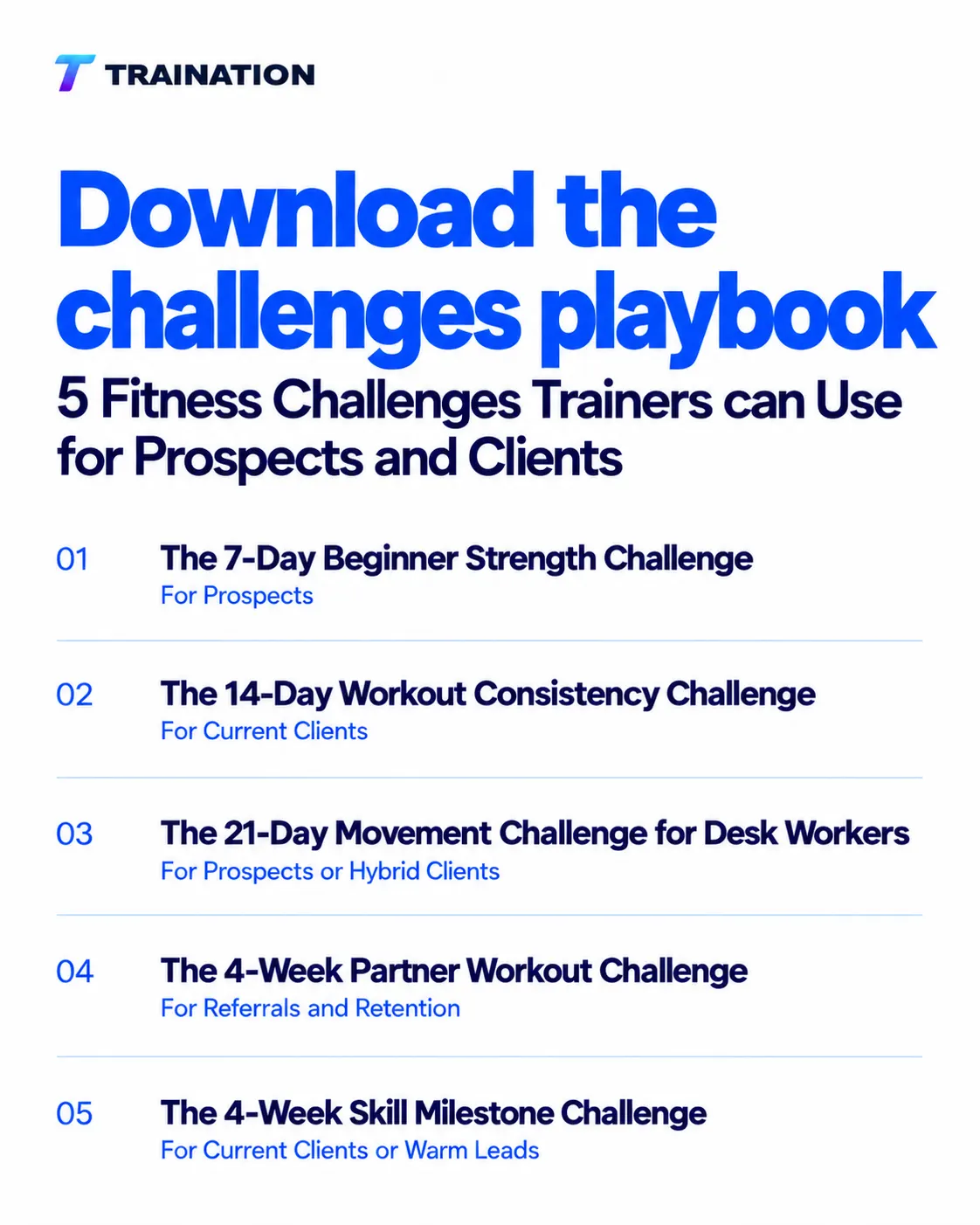
Click Here to download your free Challenges Playbook(no opt-in required).
How to Convert Challenge Participants Into Personal Training Clients (And Track ROI)
To know if a challenge actually worked for your business, track the funnel from initial sign-up all the way to long-term retention:
Eligible Registrations: Count the registrants who actually fit your target audience.
Activation Rate: Define activation in advance, such as completing the first assigned workout. Measuring activation shows how many registrants actually get started.
Completion Rate: Track how many activated participants finish the challenge.
Consultations and Paying Clients: Count how many finishers book a consultation and move into ongoing coaching.
Client Acquisition Cost: Calculate what it actually cost to sign each new client using your ad spend, prizes, and staff hours:

90-Day Continuation: For existing clients, compare their attendance and 90-day continuation against similar prior cohorts, keeping seasonal differences and self-selection in mind.
Frequently Asked Questions
Should a personal training fitness challenge be free or paid?
Whether you run a free or paid challenge depends on how much coaching time it requires. If the challenge is a low-workload 7-day introduction designed to let prospects sample your instruction, free entry lowers the barrier to join. If you are providing individual exercise modifications, form reviews, and personal follow-ups over several weeks, charging a fee helps cover your staff time and filters for serious prospects.
What are the best fitness challenge ideas for beginners?
The best beginner challenges act as a small, low-pressure trial of your actual coaching. A 7-day beginner strength introduction, built around two short workouts, one technique lesson, and a personal follow-up, lets inexperienced lifters see how you adapt exercises to their ability without overwhelming them.
How do you score a fitness challenge for clients?
Score clients on completing their individually prescribed sessions or hitting manageable weekly habit targets rather than ranking them by weight loss or daily maximal workouts. Use a weekly points cap so nobody is rewarded for overtraining, and make sure scheduled recovery days count as legitimate successes.
How long should a gym fitness challenge last?
Match the duration to the goal of the challenge. A 7-day format works well for introducing cold prospects to beginner strength training, a 14-day window is useful for helping existing clients reset their attendance after a disruption, and a 21-day or 4-week block gives enough time to build workday movement habits or practice a specific lifting skill.
Want early access to Traination?
Join the beta list to try new features early and help shape the app for coaches.