
Why a Boring Training Program Might Be Better for Client Progress
A workout can look repetitive, feel too basic, and still be producing exactly the adaptation a client needs. The difficult part is knowing when familiarity is a sign of progress and when it means the program has truly run its course. Most trainers look for the wrong signal.
The most advanced workout plan may be the one your client can actually repeat.
A program does not need to look complicated to work.
Published in March 2026, the updated ACSM position stand reviewed 137 systematic reviews involving more than 30,000 participants. It was the organization’s first major update to its resistance training guidance since 2009. Its broad conclusion was refreshingly practical: regular resistance training produces meaningful improvements, while many of the finer programming details matter less than people assume.
For personal trainers, this is not an argument against intelligent programming, but for putting complexity in its proper place.
So, how often should you change a client's workout program?
Probably less often than fitness culture would have you believe.
There is no universal number of weeks after which a workout must change. If the exercises still match the client’s goals, performance is improving, and the program remains tolerable and engaging, there may be no reason to replace them.
Progress the training first. Change the exercises when the current ones stop serving a clear purpose.
For personal trainers, this is not an argument against intelligent programming. It is an argument for putting complexity in its proper place.
The fitness industry rewards novelty
Novelty is easy to sell.
A new exercise catches attention on social media. A new workout split feels promising to clients. A complicated training method sounds more advanced than performing the same squat, row, press, and hinge patterns again next week.
Clients can feel this pressure too.
After repeating an exercise for a few sessions, they may ask:
“Shouldn’t we change this?”
“Has my body adapted?”
“Am I going to plateau?”
Sometimes the answer is yes. A program eventually needs to progress.
But progression and variety are not the same thing.
A client can make meaningful progress while repeating the same core movements. They may use slightly more weight, complete another repetition, move with better control, improve their range of motion, or finish the session with less fatigue.
The exercise did not change.
The client did.
Repeating an exercise is how you become better at it
Imagine teaching someone to play the piano, swing a golf club, or speak a new language.
You would not introduce an entirely new set of skills every week simply to keep the experience interesting. You would give them enough repetition to become more capable.
Strength training works in much the same way.
When clients repeat an exercise, they have an opportunity to improve their coordination, confidence, technique, and ability to produce force. The movement becomes less unfamiliar, allowing them to focus on doing it well rather than merely figuring it out.
This is particularly important for general-population clients.
Most are not trying to peak for a competition. They are trying to get stronger, move more comfortably, improve their health, and make exercise a reliable part of their week.
For those goals, a simple workout program is often an advantage.
It reduces the amount of mental energy required to train. It makes progress easier to measure. It gives the trainer time to coach the movement instead of constantly teaching a new one.
Familiarity is not always a sign that the program has stopped working.
Sometimes it is a sign that the client is finally ready to get more from it.
What the new ACSM guidance actually says
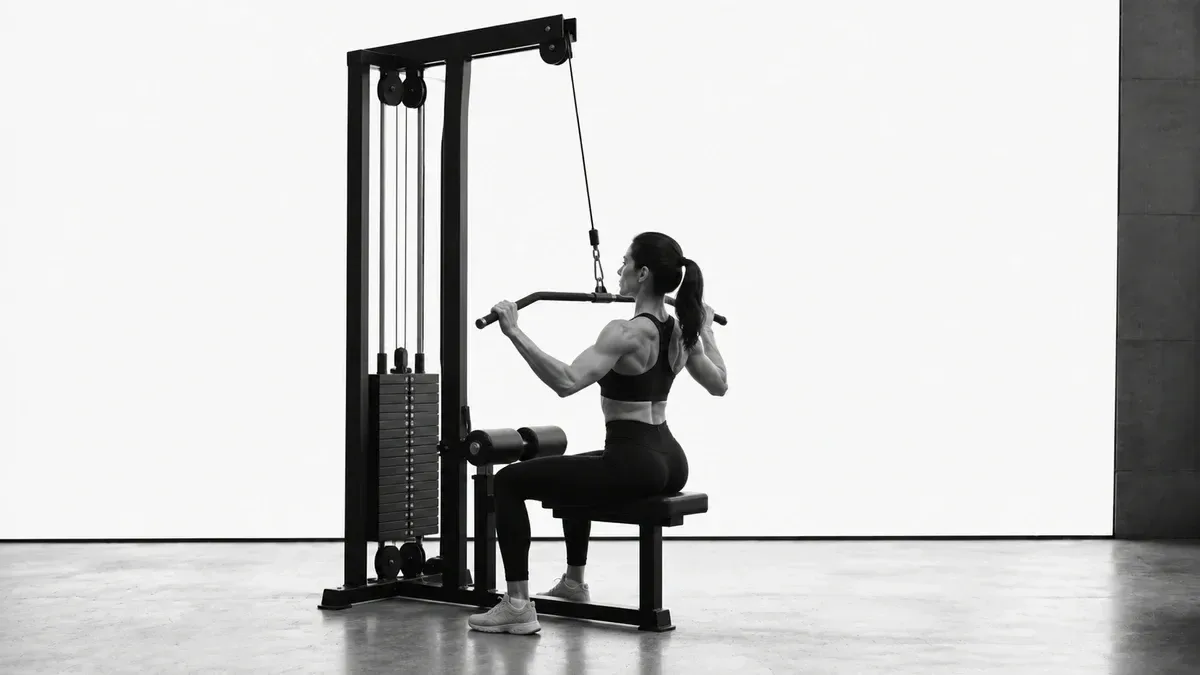
The ACSM review found that resistance training improves a wide range of outcomes, including strength, muscle size, power, endurance, balance, walking speed, and other measures of physical function.
The biggest step for most adults is not moving from a good program to a theoretically perfect one.
It is moving from no resistance training to consistent resistance training.
ACSM recommends training the major muscle groups at least twice per week. It also notes that barbells are not required. Machines, resistance bands, bodyweight exercises, free weights, and home-based routines can all produce meaningful benefits.
The review also found that several techniques commonly presented as essential were not consistently necessary for the average healthy adult. These included training to muscular failure, choosing one specific type of equipment over another, and using complex periodization systems.
That does not make those methods useless.
It means they are tools, not entry requirements.
Simple does not mean random
There is an important distinction here.
A simple strength training program can still be thoughtful. A random collection of exercises is not automatically effective just because it is easy to follow.
A useful program still needs a purpose.
It should train the movement patterns and muscle groups that matter for the client’s goals. It should provide an appropriate level of challenge. It should account for the client’s experience, health, preferences, schedule, and ability to recover.
Most importantly, it should include some form of progressive overload.
Progressive overload simply means that the training challenge develops as the client becomes more capable.
That could involve:
Lifting slightly more weight
Completing more repetitions with the same weight
Adding a set
Improving range of motion
Using better control
Performing a more difficult version of the movement
Completing the same work with better technique
Resting less when that supports the goal
Progression does not require changing every exercise.
In many cases, keeping the exercises stable makes progression easier to see.
Exercise variation is a tool, not the goal
Exercise variation means changing a movement, its equipment, its execution, or its place within the program.
A trainer might replace a goblet squat with a front squat, switch from dumbbells to a barbell, change the number of repetitions, or use a different tempo.
These changes can be useful.
But changing an exercise is only one way to adjust a resistance training program. It is not automatically more effective than progressing the movement the client is already performing.
Variation should solve a problem.
It might create a new challenge, better match the client’s goal, accommodate discomfort, renew motivation, or make the exercise more appropriate for the client’s current ability.
Without a reason, variation can become movement for the sake of movement.
A simple example
Consider a client performing a goblet squat.
During the first week, they use a 20-pound dumbbell for three sets of eight repetitions. Their depth is inconsistent, and they need several reminders to maintain their position.
Two weeks later, they use the same weight for three sets of ten. Their movement looks more controlled.
A few weeks after that, they perform three sets of eight with a 25-pound dumbbell.
From the outside, the program may look repetitive. The client is still doing goblet squats.
But the training is not the same.
The client is handling more work, moving with greater skill, and producing more force. That is progress.
Changing the goblet squat to an entirely different squat variation every week might make the program appear creative, but it could also make that progress harder to develop and harder to measure.

How often should you change your workout program?
A workout should change when there is a reason, not because a fixed number of weeks has passed or because the client must constantly be entertained with new exercises.
There is no universal rule that says a workout program must change every four, six, eight, or twelve weeks.
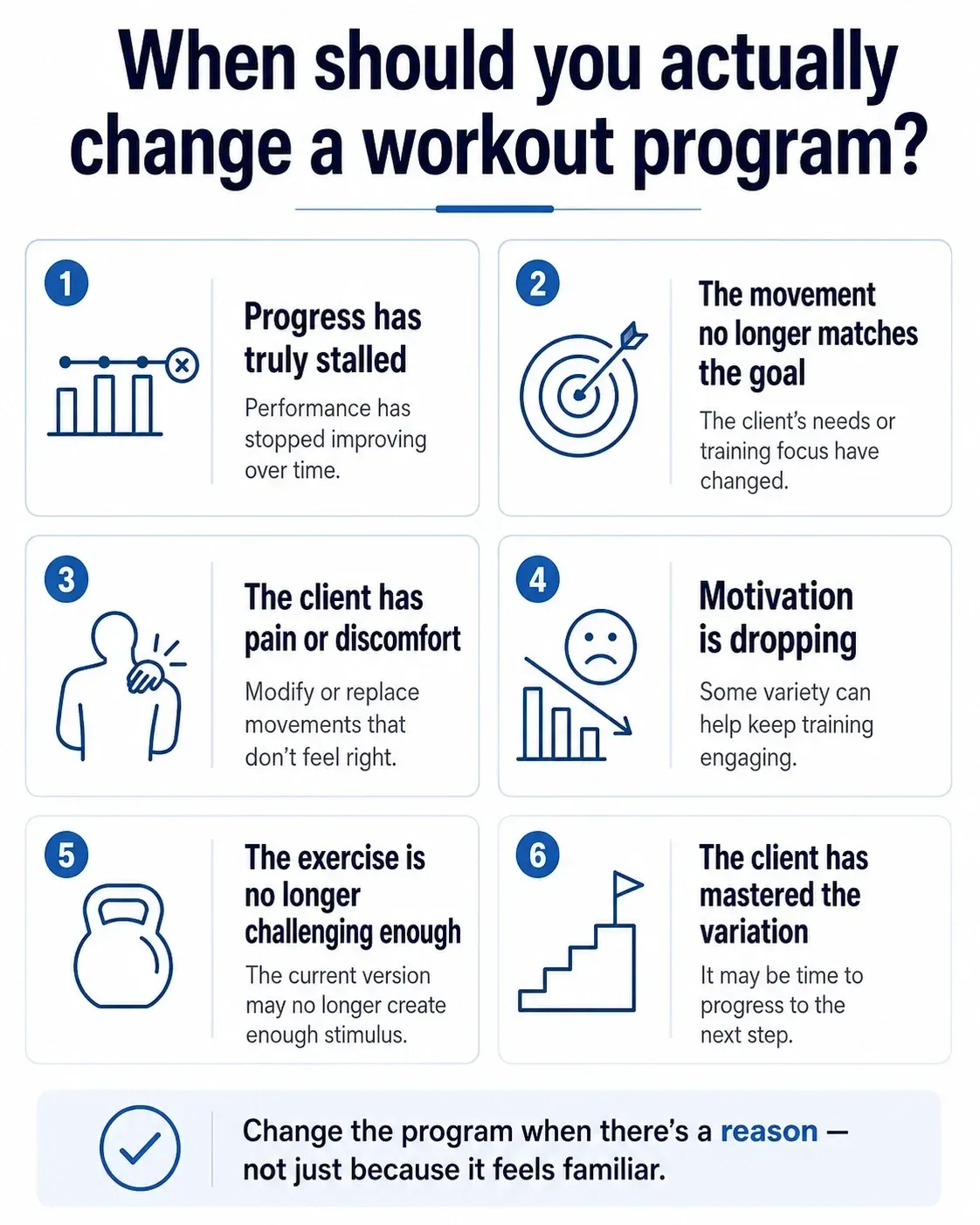
A change may be useful when:
The current exercise no longer matches the goal
A client may have developed enough skill or strength to move to a more challenging variation. Their goals may also have changed.
Progress has genuinely stalled
One difficult session is not a plateau. But if performance has stopped improving over a meaningful period, despite consistent attendance and adequate recovery, an adjustment may help.
Before replacing the exercise, the trainer should also consider whether the client’s sleep, nutrition, effort, stress, or training consistency may be affecting progress.
The movement causes discomfort
Pain should not be ignored for the sake of program consistency. The exercise may need to be modified, replaced, or referred out when appropriate.
The client cannot perform it safely or confidently
An exercise that looks effective on paper is not useful if the client cannot execute it well.
Motivation is beginning to fall
Enjoyment matters because adherence matters. Some variety can keep training engaging, provided it does not erase the structure of the program.
The client has mastered the current challenge
Progression may eventually require a new variation, a different loading strategy, or more specific programming.
The key question is not, “Have we done this exercise before?”
It is, “Is this exercise still helping the client move toward the goal?”
When complexity earns its place
More advanced programming becomes useful when the goal becomes more specific.
An athlete preparing for a competitive season may need carefully planned training phases. A powerlifter may need precise management of intensity, volume, and fatigue. An experienced lifter trying to maximize muscle growth may benefit from closer attention to weekly training volume.
The ACSM guidance reflects this distinction. For example, it suggests heavier loads for maximizing strength, greater weekly volume for hypertrophy, and moderate loads moved quickly when developing power.
Specific goals deserve specific programming.
But most general-population clients do not need an athlete’s program simply because it looks more advanced.
They need a program that fits their life and gives them a clear way to improve.
Trainers do not need to prove their value through exercise variety
This may be the more uncomfortable lesson.
Some trainers worry that repeating a workout will make clients question the value of coaching.
If the client already knows the exercises, what are they paying for?
But the trainer’s value was never supposed to come from possessing an endless library of movements.
It comes from knowing:
Which exercises suit the client
How much work they need
When to push and when to pull back
How to coach better execution
How to adapt around limitations
How to recognize real progress
When a program needs to change
How to keep the client consistently participating
A trainer who changes exercises constantly can look busy.
A trainer who knows exactly what to keep, what to progress, and what to remove is coaching.

What to tell a client who thinks repetition means being stuck
A client-friendly explanation might sound like this:
We are repeating these movements because we want you to become stronger at them. The workout will not stay exactly the same. We will gradually increase the challenge as your technique, strength, and confidence improve. Repeating an exercise is not being stuck. It is what allows us to measure progress.
That explanation gives the client a reason for the repetition.
It also shifts their attention away from novelty and toward improvement.
Instead of asking, “Is this exercise new?” they can begin asking:
“Am I doing it better?”
“Can I lift more?”
“Does this feel more controlled?”
“Am I more confident than I was last month?”
Those are much more useful questions.
Frequently asked questions
Is it bad to repeat the same exercises every week?
No. Repeating the same exercises can help a client improve their technique, coordination, confidence, and strength.
The program should continue to progress, but that does not mean the exercise selection must constantly change.
Can your body get used to the same workout?
Yes, but adaptation is the goal of training.
As the body adapts, the trainer can increase the challenge through more weight, repetitions, sets, range of motion, control, or exercise difficulty.
The fact that a client has adapted to an exercise does not automatically mean the exercise should be removed.
Is progressive overload the same as changing exercises?
No.
Progressive overload means gradually increasing the demands of training as the client becomes more capable. Changing an exercise is only one possible way to do that.
In many cases, a trainer can create progressive overload while keeping the same core exercises in place.
How do you know when a workout routine has stopped working?
A program may need attention when progress has stalled for a meaningful period, the exercises no longer match the client’s goal, discomfort appears, or motivation and adherence are declining.
Before changing the routine, consider whether the client has been attending consistently, training with enough effort, and recovering adequately.
How often should beginners change their workout routine?
Beginners often benefit from keeping their main exercises consistent long enough to develop skill and confidence.
Small adjustments can still be made, but constantly replacing movements may make it harder for a beginner to learn proper technique and recognize progress.
Build a program that survives real life
The perfect workout program is not the one with the most moving parts.
It is the one a client can follow during a busy workweek. The one they understand. The one that does not require a different machine every five minutes. The one that allows the trainer and client to see whether anything is improving.
A program can be scientifically sound and still fail because it is too difficult to follow consistently.
It can also look surprisingly ordinary and work extremely well.
The new ACSM guidance does not suggest that programming decisions are irrelevant. It suggests that we should not allow smaller details to distract us from the largest one:
People have to keep training.
There is no fixed rule for how often you should change your workout routine. Keep effective exercises in the program long enough to build skill and measure progress. Change them when the client’s goals, abilities, comfort, motivation, or rate of progress give you a reason.
For many clients, the next breakthrough will not come from a more complicated workout.
It will come from doing the important things well enough, and long enough, for them to work.
References:
- ACSM overview of the new resistance-training position stand:
https://acsm.org/science-spotlight-acsm-releases-new-position-stand-on-resistance-training/ - Full position stand in Medicine & Science in Sports & Exercise:
https://journals.lww.com/acsm-msse/fulltext/2026/04000/american_college_of_sports_medicine_position.21.aspx - ACSM presentation summarizing the evidence and recommendations:
https://acsm.org/wp-content/uploads/2026/03/Pronouncement-ppt-deck_resistance-training-ps.pdf - ACSM’s five practical takeaways for building an effective resistance-training plan:
https://acsm.org/effective-resistance-training-program-infographic/
Want early access to Traination?
Join the beta list to try new features early and help shape the app for coaches.