
Your Weekly Client Check-In Is Probably Asking the Wrong Questions
A completed check-in is not automatically a useful one. The right questions can help a trainer decide what to do next.
A common weekly client check-in goes something like this: workouts completed, sleep rated, water tracked, motivation scored, wins listed, challenges explained. The client submits it. The trainer replies with encouragement. Then the same plan rolls into Monday unchanged.
Plenty of personal trainer client check-in questions collect information. Fewer help a trainer make a decision.
That distinction matters. A check-in is not useful because it is detailed, automated, or completed on time. It is useful when it closes the gap between the plan you wrote and the week your client actually experienced.
The ideal check-in should help you decide what to do next: stick to the plan, clear up any confusion, make the goal easier, change the program, or talk about a problem that might need outside help. If an answer wouldn’t change how you coach, it probably doesn’t need to be on the form.

What a client check-in must reveal
Check-ins are often treated as accountability tools. That is only part of their job. Accountability without interpretation can become little more than weekly reporting.
A useful check-in should reveal six things:
Adherence: What did the client actually complete?
Recovery: How well are they tolerating the current workload?
Friction: What made the plan difficult to execute?
Confidence: Does the next step feel achievable?
Upcoming obstacles: What could disrupt the coming week?
Adjustment: What is the smallest change that would make the plan work better?
This approach fits what behavior-change research suggests without pretending that one form can guarantee adherence. A meta-analysis of 138 progress-monitoring interventions found that increasing progress monitoring produced a meaningful improvement in goal attainment. Its effects were stronger when progress was recorded or reported, and when monitoring was combined with techniques such as feedback and action planning.
The important word is combined. Recording what happened may help, but the real coaching value appears when that information informs feedback and the next action.
Research on prescribed exercise supports similar caution. A 2023 systematic review found low-certainty evidence that self-monitoring and feedback improved adherence in some trials. That is encouraging, but it is not proof that weekly check-ins, a particular score, or a longer form will work for every client.
Your check-in still needs judgment.
Every question must reveal actionable context and drive a specific coaching decision.
Weekly check-ins and monthly reviews have different jobs
How often should personal trainers check in with clients? Weekly is a sensible starting point for many coaching relationships, particularly when clients train independently between sessions. But it is not a universal law.
The right cadence depends on the client, the service, the program stage, and how much useful information can change from one check-in to the next. A new online client may benefit from a short weekly pulse check.
A more experienced client may need less. Someone navigating a difficult schedule may need brief contact before the usual check-in day rather than a larger questionnaire afterward.
The common mistake is asking a weekly check-in to do the work of a monthly review.
A weekly check-in should catch immediate signals:
completed training and habits;
unusual fatigue, soreness, or recovery problems;
obstacles that affected execution;
confidence about the next week;
scheduling problems already visible on the horizon.
A monthly review should examine the larger direction:
trends in performance and agreed progress measures;
whether the goal still matters to the client;
satisfaction with the coaching process;
recurring barriers rather than one difficult week;
whether the program, support, or communication cadence needs to change.
Keeping those jobs separate makes the weekly form shorter and the monthly conversation more meaningful.
Six personal trainer client check-in questions worth asking
There is no perfect universal template, but these six questions create a useful core. Each one exists because it can lead to a coaching decision.
1. What parts of the plan did you complete?
Ask for observable behavior before asking for an explanation. This could include planned workouts, walks, practice sets, or one agreed habit. Compare the answer with information already recorded so the client does not have to reproduce data you possess.
The purpose is not to make clients feel bad about their adherence, but to clearly establish what really occurred in a client's life.
2. What helped, or got in the way?
Two clients can miss the same workout for entirely different reasons. One had an unpredictable work deadline. One was still unusually sore. One avoided a session that felt intimidating.
Those are different coaching problems. They should not receive the same motivational reply.
3. How well are you recovering from the current workload?
Keep this within a trainer's scope. Ask about the client's experience of energy, soreness, sleep, and readiness to train. Look for changes from their normal pattern rather than treating an isolated score as a diagnosis.
Reports of pain, medical symptoms, severe fatigue, or concerns outside your qualifications may require modification, a deeper conversation, or referral not a confident interpretation from a form.
4. How confident are you that you can complete next week's plan?
A simple scale can open a valuable conversation, but the follow-up matters more than the number. If confidence is low, ask what would move it up by one point.
This shifts the conversation from “Are you motivated?” to “What would make this plan feel more achievable?” Motivation is broad. Confidence about a specific action gives you something you can coach.
5. What is most likely to disrupt the coming week?
Most check-ins look backward. Good coaching also looks ahead.
A client may already know about travel, childcare changes, a deadline, poor gym access, or a social event. Finding out afterward produces an explanation. Finding out beforehand creates a planning opportunity.
6. What one adjustment would make the plan more realistic?
The client does not have to write the program for you. This question helps reveal where the plan and real life are rubbing against each other.
The answer might suggest shorter sessions, a different training day, clearer exercise instructions, fewer simultaneous habits, or no change at all. Your job is to interpret the request alongside the goal and the evidence you have, not automatically grant or reject it.

Change the questions as the client changes
Consistency makes trends easier to spot, so the entire form should not be reinvented every Friday. But a fixed form can keep asking questions that no longer matter.
Keep a stable core and rotate one or two prompts according to the client's stage:
New client: Emphasize clarity, confidence, unexpected soreness, and whether the program feels overwhelming.
Building consistency: Focus on scheduling friction, environmental barriers, and which actions are becoming easier to repeat.
Progressing client: Give more attention to performance, recovery, exercise execution, and tolerance of the current workload.
Plateau: Compare recent behavior and outcomes with longer trends. Revisit execution, expectations, and whether the original goal still fits.
Maintenance: Ask about autonomy, enjoyment, new priorities, and whether the current level of support remains useful.
The check-in should evolve because the coaching problem evolves.
How to interpret client check-in answers
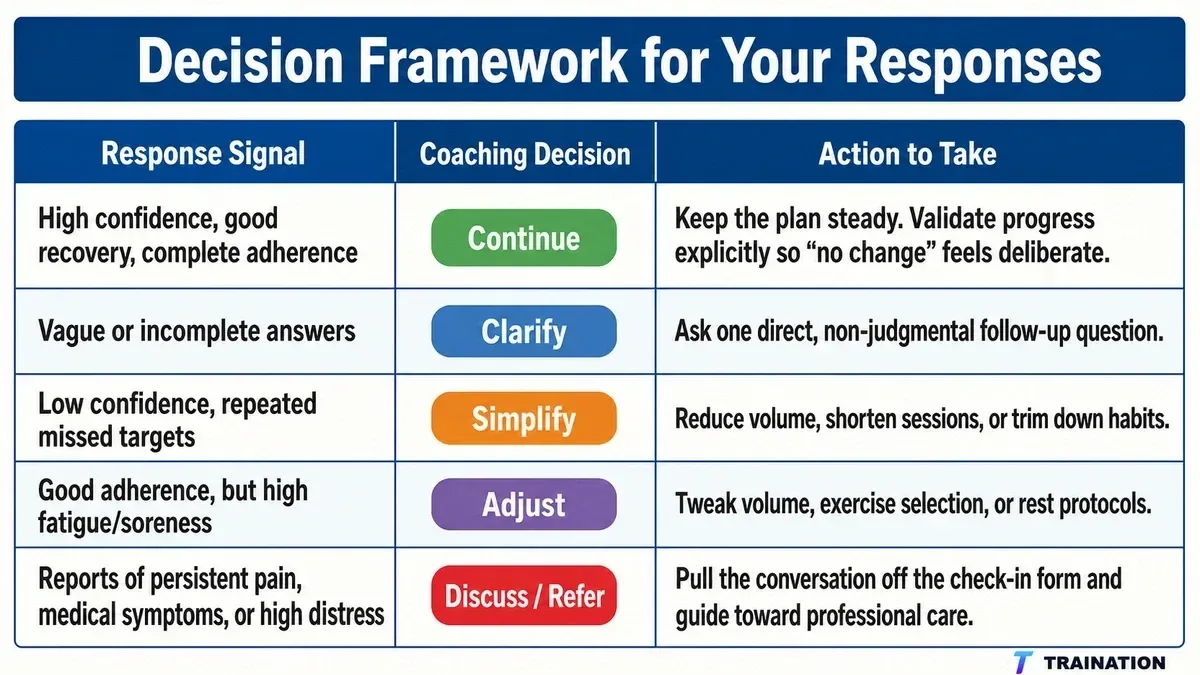
Collecting answers is the easy part. Use five response paths to decide what follows.
Continue
The plan is being completed, recovery is within the client's normal range, confidence is solid, and no meaningful obstacle requires a change. Say what you noticed and why you are keeping the plan stable. “No change” should still feel like a coaching decision.
Clarify
The answer is vague, incomplete, or inconsistent with the available information. Ask one focused follow-up instead of making an assumption. “What got in the way?” is more useful than deciding the client lacks discipline.
Simplify
Adherence and confidence are both falling, or the client is repeatedly overwhelmed. Consider reducing the number of targets, shortening a session, or defining a minimum version of the plan. Simplifying the next action is not the same as abandoning the goal.
Adjust
The client is executing consistently, but recovery, performance, enjoyment, or progress suggests the plan deserves review. The adjustment might involve training volume, exercise selection, scheduling, progression, or the agreed behavior target.
Discuss or refer
Some responses should not be solved inside a check-in thread. Pain, medical symptoms, disordered eating concerns, or significant mental-health issues may require an appropriate healthcare professional. The form can alert you to a concern; it does not expand your professional scope.
The same missed session can therefore lead to five different responses. That is why the answer matters more than the box it appears in.
 When a client stops responding
A missing check-in is just one data point, not a diagnosis.
The client could be overwhelmed, embarrassed about a difficult week, confused by the form, distracted by life, less committed to the goal, or simply tired of answering questions that seem to go nowhere. Do not automatically translate silence into laziness.
Start with a calm, low-friction follow-up.
Reference something specific, remove guilt from the message, and make the next response easy.
For example: “I noticed we missed this week's check-in. Is the current plan still realistic, or is there one part we should adjust?”
Ask whether the timing, format, or frequency of the workout are still working for them. Sometimes, a two-question text message may produce more honest feedback than a ten-field form.
Set communication expectations when coaching begins, including when check-ins happen, how quickly you respond, and what happens when one is missed. That gives both sides a shared process without turning the relationship into surveillance.
How to avoid check-in fatigue
The fastest way to make clients ignore a check-in is to show them that their answers change nothing.
Remove fields you never review. Do not ask clients to re-enter workout, habit, or progress data already available to you. Limit open-text questions to the ones that genuinely need context. Use trendable scales only when you intend to compare them over time.
Most importantly, reflect the answer in your response. Name the pattern you noticed, explain the decision it produced, and identify the next action. That can be brief:
“You completed both workouts, but recovery and confidence have fallen for two weeks. Let's keep the training days and reduce the final sets this week, then reassess Friday.”
That response proves the check-in was read. It connects monitoring, feedback, and action planning. It also gives the client a clear reason for the adjustment.
Templates can save time. Automation can keep the process consistent. Neither can decide which signal matters most for this client, this week.
A useful check-in completes a coaching loop: what you planned, what the client experienced, what you learned, and what should happen next. Ask fewer questions if necessary but make every answer earn its place.
Sources
Harkin, Benjamin et al. “Does Monitoring Goal Progress Promote Goal Attainment? A Meta-Analysis of the Experimental Evidence.” Psychological Bulletin, 2016. https://cdr.lib.unc.edu/downloads/mc87px074
Peiris, Casey L. et al. “Behavior Change Techniques Improve Adherence to Physical Activity Recommendations for Adults With Metabolic Syndrome: A Systematic Review.” 2023. https://pubmed.ncbi.nlm.nih.gov/36945683/
Want early access to Traination?
Join the beta list to try new features early and help shape the app for coaches.